The first thing to know about Valley Forge is that its most useful number may be ten. That is the length, in miles, of the National Park Service's Encampment Tour driving loop: a route through Pennsylvania fields, monuments, reconstructed huts, and places tied to the Continental Army's winter of 1777–78.
The second useful number is nine. The loop has nine major stops, and the park says it can take anywhere from about 20 minutes to two or three hours by car, depending on how often you stop. A slow afternoon makes room for the stories between the landmarks.
These seven stops and planning choices are suggestions within the same park, not separate road trips or a claim that every building is open. They make a manageable first visit; check the park's current alerts and hours before setting out.
1. Begin at the visitor center with a map and a question
The visitor center is the first major stop on the Encampment Tour. Its exhibits and information desk offer a useful introduction to the place before you head out across the landscape. Pick up or consult a route map and decide how much time you have. Ask staff about current building access, road conditions, and facilities that matter to your group.
That first conversation can make the difference between a relaxed visit and a day built around assumptions. A route that works well by car may be a different undertaking on foot, and an outdoor stop is not the same as an open historic interior. The National Park Service also publishes accessibility information for the tour stops.
2. See the reconstructed huts at Muhlenberg's Brigade
At Muhlenberg's Brigade, reconstructed log huts face a gravel company street. The park identifies this as the area where troops led by Brigadier General Peter Muhlenberg camped during the winter of 1777–78. The structures provide a way to think about the everyday work of sheltering an army, beyond the names of generals and the dates in a textbook.
As you look around, remember what reconstruction means: the huts are interpretive structures, not surviving original soldiers' homes from the encampment. The distinction makes the stop more interesting, not less. It invites a question about how historians and park interpreters use evidence to make a long-vanished camp legible today.
The park notes that more than 12,000 soldiers and hundreds of civilians arrived with the Continental Army in December 1777. Their experience involved a community much larger and more complicated than a single commander.

3. Pause at the National Memorial Arch
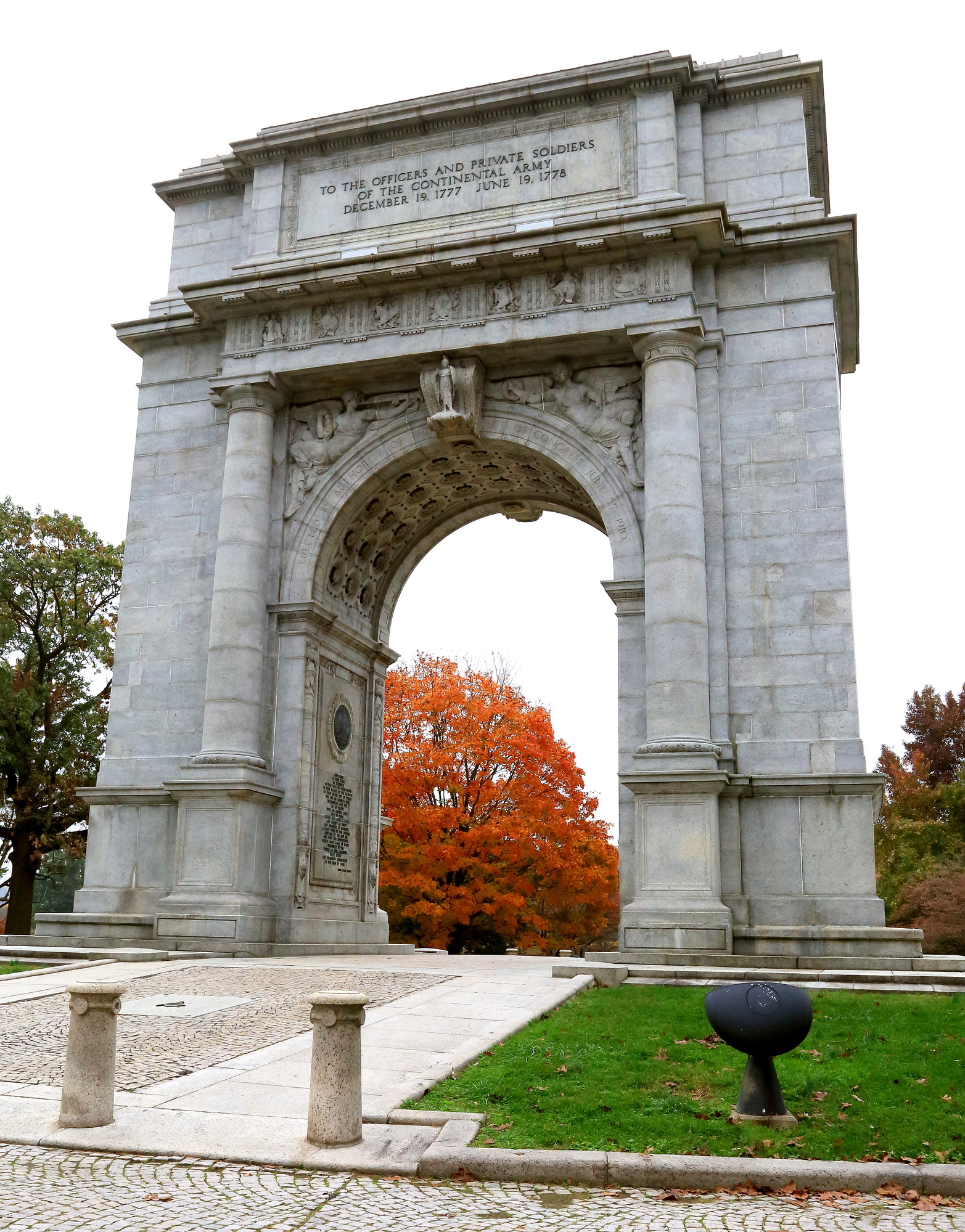
The National Memorial Arch is one of the tour's most recognizable landmarks, but it belongs to a different period from the encampment itself. The park says the monument was erected in the early twentieth century to commemorate the Continental Army's arrival and sacrifices at Valley Forge.
That difference in dates is worth keeping in mind. At the arch, you can consider both the eighteenth-century encampment and the later generations who chose to remember it through a monumental structure. Take a moment to read the interpretation and look across the surrounding landscape rather than making the monument only a quick backdrop.
For a picnic, the park identifies Wayne's Woods as an area with views of the arch and first-come, first-served tables. Amenities such as water and restrooms may be seasonal, so check before making them essential to your plan.
4. Understand Washington's Headquarters before expecting an interior tour
Washington's Headquarters, also called the Isaac Potts House, was used by George Washington and his household during the encampment. It is a major stop on the route and helps connect the broad landscape to the people who lived and worked here.
There is a timely planning detail: the park says the house closed to visitors on May 4, 2026, for restoration and is expected to remain closed into 2027. Check the official operating-hours page for updates before promising anyone an interior visit. Even when the building is closed, current park guidance can tell you what portions of the area and interpretation remain available.
This is a good example of why a list of historic places should never substitute for a current operating schedule. A stop can be historically significant while its visitor experience changes from season to season.
5. Look for the defenses at Redoubt 3
Redoubt 3 is another of the nine major tour stops. A redoubt is a defensive earthwork, and the stop adds a different dimension to a visit that might otherwise focus on buildings and monuments: the army also had to consider how it would protect its position.
Use the park's interpretation and map to understand what you are seeing. Earthworks can be less immediately obvious than a stone monument, so they reward a slower look and a little context. Conditions, access, and the amount of walking at a stop may change; use the park's accessibility information and current notices to decide what works for you.
6. Give the route more than the minimum
The park describes the ten-mile loop as suitable for a first-time visit by vehicle. Its wide range of estimated driving times reflects a real choice: you can move around the loop quickly, or you can stop, read, and explore. If you have a couple of hours, select a handful of places that interest you and leave room for the unexpected.
Seasonal trolley tours and other ways to experience the route may be available through park partners. Schedules and reservations can change, so verify them before planning around a particular tour. The park also notes that larger vehicles may need a modified route to avoid tight spots.
7. Make space for a walk that fits your group
The park is more than its auto route, but a walk should be chosen with the same care as a drive. Review the current trail map, surfaces, distances, and weather. Decide how much walking is comfortable for the least mobile member of your party, and ask about accessible facilities where needed.
One option to investigate is the paved Joseph Plumb Martin trail, which the park's tour information describes as a five-mile loop near Wayne's Woods. You do not need to walk the entire loop to appreciate a section, and a paved surface alone does not establish that every stretch meets every visitor's accessibility needs. Check the park's detailed accessibility guidance before you go.
Before you leave home
Check the National Park Service's official tour, operating-hours, and accessibility pages for the day of your visit. Valley Forge works especially well when the route serves your interests: a few carefully chosen stops can tell a richer story than a hurried effort to see everything.