The Oklahoma City National Memorial & Museum preserves a place of loss, remembrance and resilience in the heart of downtown. On April 19, 1995, a bomb destroyed much of the Alfred P. Murrah Federal Building and killed 168 people. The outdoor memorial honors those who died, those who survived, rescuers and everyone changed by the attack.
This is a place to slow down. The Outdoor Symbolic Memorial is free and open around the clock, while the adjacent museum offers a separate, ticketed experience. Allow time for both if you can, and approach the grounds with the consideration you would bring to any place of remembrance.
Begin between the Gates of Time
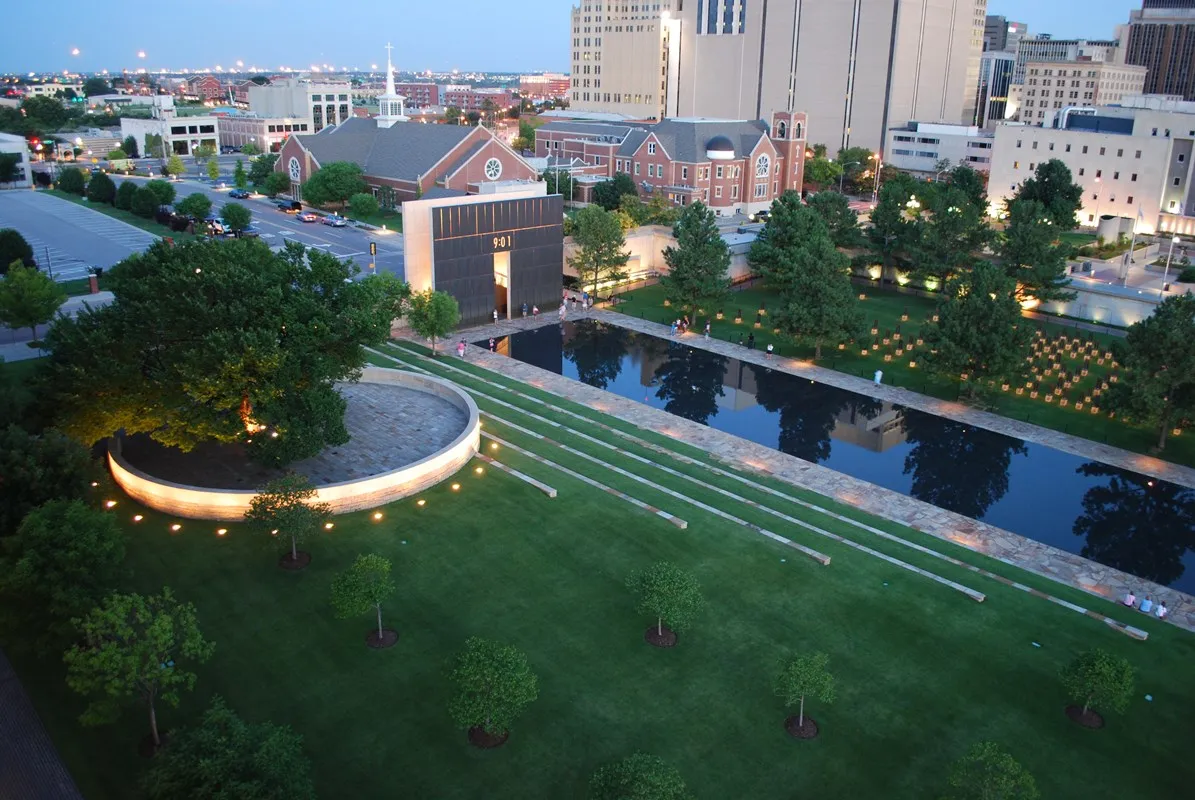
Two monumental gates mark 9:01 and 9:03, framing 9:02 a.m., the minute of the bombing. Between them, a reflecting pool occupies the former path of Northwest Fifth Street. The design invites visitors to consider the moment before the attack and the beginning of recovery afterward.
Walking from one gate to the other is an accessible way to start orienting yourself. Stop by the water, read the interpretive information and give others space for quiet. The grounds remain open 24 hours a day, but weather and special events may affect the experience; check the memorial's current information before arriving.
Spend time at the Field of Empty Chairs
The field occupies the former footprint of the federal building. Each of its 168 chairs bears the name of someone killed. Nineteen smaller chairs represent children. Most chairs are arranged in nine rows corresponding to the building's floors; five others represent people who died outside the building.
The chairs are illuminated after dark. Whether you visit by day or evening, take time to read the names and remember the individual lives represented. This is a memorial rather than a playground or a backdrop for a hurried photo; be mindful of families and other visitors paying their respects.
Find the Survivor Wall and the Survivor Tree
At the eastern end of the field, the Survivor Wall incorporates surviving parts of the Murrah Building and holds names of people who lived through the attack. The original surfaces make the connection between the present memorial and the building that stood here tangible.
The Survivor Tree, an American elm that endured the bombing, stands on the opposite side of the grounds. Nearby, the Rescuers' Orchard honors those who came to help. These features tell a story of response and survival alongside the memorial's acknowledgment of lives lost. Take the paths slowly and read the site's descriptions rather than assuming every element has an obvious meaning.
Notice the Fence and Children's Area
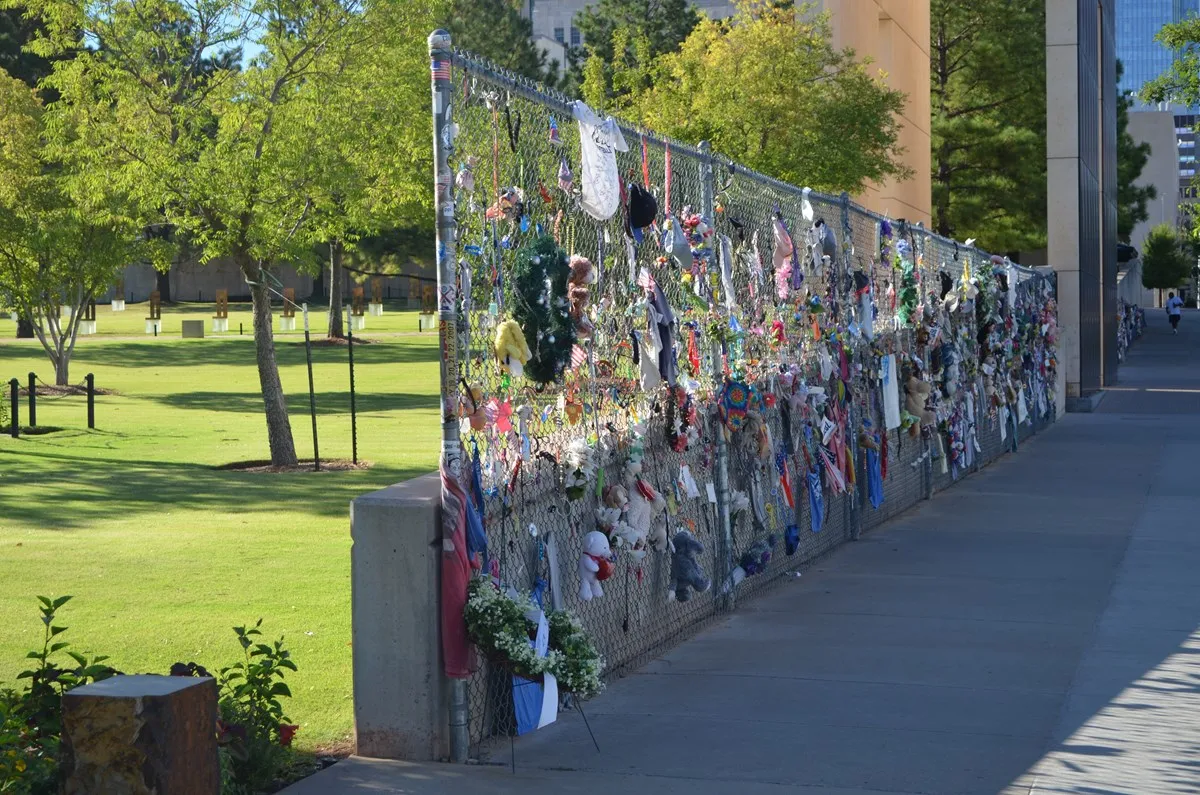
After the bombing, a fence surrounding the site became a place where people left messages and tokens of grief. A section remains part of the memorial, continuing that tradition of remembrance. The Children's Area includes expressions of sympathy from young people, including painted tiles.
For families, these features may offer a starting point for an age-appropriate conversation. Ask a National Park Service ranger about available children's programs, and consider what your child is ready to encounter before entering the museum. Visitors have different connections to the tragedy, so a respectful tone and awareness of others matter throughout the grounds.
Give the museum its own time
The Memorial Museum is housed in the former Journal Record Building and tells the story through exhibits and accounts from people affected by the bombing. The museum operator suggests an average visit of about an hour and a half; the NPS recommends allowing roughly two hours. The material includes a difficult account of violence and loss, so plan breaks if needed.
The operator currently lists hours of 9 a.m. to 5 p.m. Monday through Saturday and noon to 5 p.m. Sunday, with the last ticket sold one hour before closing. Holiday closures apply. Admission is separate from the free outdoor grounds, and prices and availability can change. Check the official museum site for current tickets, accessibility information and hours before visiting.
Plan a respectful visit
The museum entrance is at 620 North Harvey Avenue. The memorial operator lists designated accessible parking and entrances; consult its current accessibility information or contact staff about specific needs. The NPS says pets are not allowed on the memorial grounds or in the museum. Photography is permitted, but take care not to intrude on other visitors.
Bring water and dress for the season, especially if you plan to spend time outside. For a first visit, allow at least an hour for the grounds plus museum time, and leave space afterward to reflect. The site is both a place to learn about April 19, 1995, and a lasting tribute to people whose lives were changed that day.